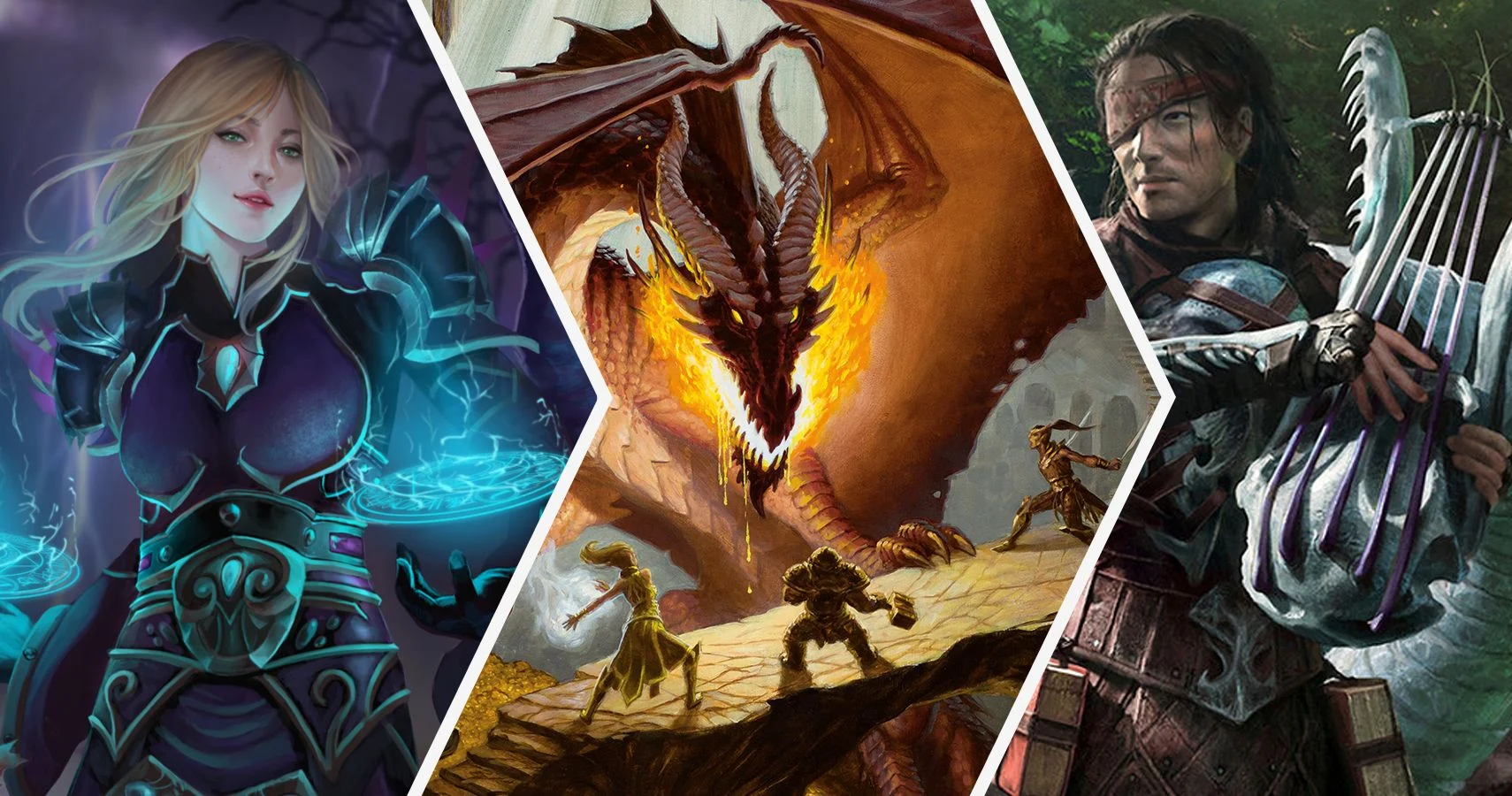
WHAT IS DUNGEONS AND DRAGONS?
The Dungeons and Dragons roleplaying game is about storytelling in worlds of swords and sorcery. Like childhood games of make-believe, D&D is driven by imagination. It’s about picturing the towering castle beneath the stormy night sky and imagining how a fantasy adventurer might react to the challenges the scene presents.
Unlike a game of make believe, D&D gives structure to the stories, a way of determining the consequences of the adventurers action. Players roll dice to resolve whether their attacks hit or miss or whether their adventurers can scale a cliff, or pull off some other dangerous task. Anything is possible, but the dice make some outcomes more probable than others.
In the D&D game, each player creates an adventurer (also called a character) and teams up with other adventurers (played by friends). Working together, the group may explore a dark dungeon, haunted castle, a lost temple, or more.
WHERE TO START?
The first step in starting your D&D adventure is to create a character. Each adventurer is a member of a class, which broadly describes the special talents they possess and the tactics he or she is most likely to employ in battle or while exploring. Your character receives a number of benefits from your choice of class including a number of proficiencies (armor, weapons, skills). Your proficiencies define many of the things your character can do particularly well, from using certain weapons to telling a convincing lie. While adventurers may advance in more than one class as time goes on, the twelve basic classes can be generally categorized into three groups.

Strength
Strength measures a character’s muscle, endurance and stamina. This ability is the prime requisite of warriors because they must be physically powerful in order to wear armor and wield heavy weapons. Exceptional strength improves the character's chance to hit an enemy, increases the damage he causes with each hit, increases the weight the character is able to carry without a penalty for encumbrance, and increases the character's ability to force open doors and similar portals.

Support
Support characters may not be able to take as much damage or cast as many spells as others, but their unique toolkit of skills is their route to success. Often a skill of high importance is dexterity, which encompasses several physical attributes including hand-eye coordination, agility, reaction speed, reflexes, and balance. Dexterity affects a character's reaction to a threat or surprise, his accuracy with thrown weapons and bows, and his ability to dodge an enemy's blows.

Spellcasting
Spellcasters mainly rely on specializing in intelligence. Intelligence represents a character's memory, reasoning, and learning ability, including areas outside those measured by the written word. Intelligence dictates the number of languages a character can learn and iis the prime requisite of many magic users, who must have keen minds to understand and memorize magical spells. The magic user’s intelligence dictates which spells he can learn and the number of spells he can memorize at one time.